
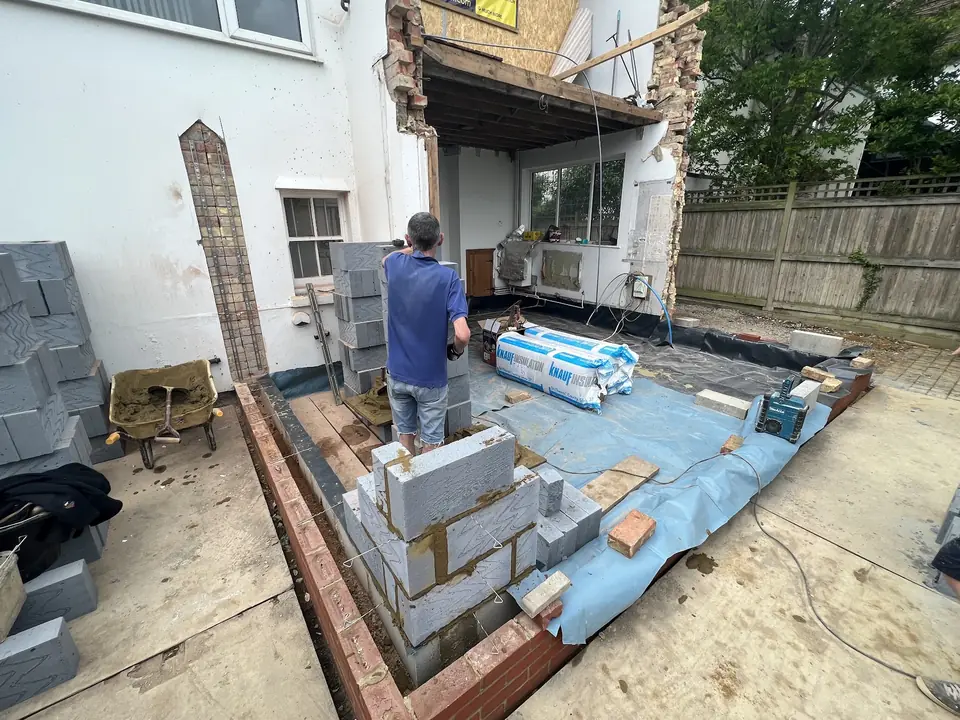
Whether you are setting out footings for an extension, a garden wall or a shed base, the corners need to be square. Get them wrong at the start and every course of blocks, every joist and every tile after that will show it. Here is how to get them right with nothing more than a tape.
How it works
Measure 3 along one side
Measure 4 along the other
Check for 5 across the diagonal
Mark a point 3 units along one line from the corner, and 4 units along the other. Then measure the diagonal between those two marks. If it is exactly 5, your corner is 90 degrees. If it is more than 5, the corner is too open. If it is less, it is too tight. Move one line until the diagonal reads 5.
Why it works
It is Pythagoras: 3 squared (9) plus 4 squared (16) equals 5 squared (25). Any triangle whose sides fit that rule has a right angle between the two shorter sides. You do not need to remember the maths to use it, but it helps to know why it never lets you down.
Use any unit, or any multiple
The rule works in feet, metres or anything else, as long as you keep the same ratio. Some useful sets:
| Side one | Side two | Diagonal | Good for |
|---|---|---|---|
| 0.6 m | 0.8 m | 1.0 m | Small bases, tiling |
| 0.9 m | 1.2 m | 1.5 m | Garden walls, sheds |
| 1.5 m | 2.0 m | 2.5 m | Footings and slabs |
| 3 m | 4 m | 5 m | Extensions |
| 6 m | 8 m | 10 m | Large setting out |
Tips from site
- Go as big as the job allows. A small error over 0.6 m becomes a big one over 6 m. The bigger the triangle, the more accurate the corner.
- Measure from the same point every time. Always the same side of the string line, or the centre of the peg.
- Get a second pair of hands. One person holds the tape on the mark while the other reads the diagonal.
- Check rectangles with the diagonals. Once all four corners are set out, measure both diagonals. If they match, the whole shape is square.
- Check again before you dig or pour. Pegs get knocked. Thirty seconds with a tape is cheaper than a wall that is out of square.
Where you will use it
Setting out footings and walls, laying a slab, building a stud wall, fitting a kitchen, starting a tiled floor from a square line. Once you know it, you will use it on almost every job. You can see what happens after the setting out in our extension build diary.